How to read a nutrition label in 30 seconds
Learning how to read a nutrition label takes a few minutes, and after that about 30 seconds per package. Start with the serving size, then check calories, protein, fiber and added sugars. Most of the rest can wait.
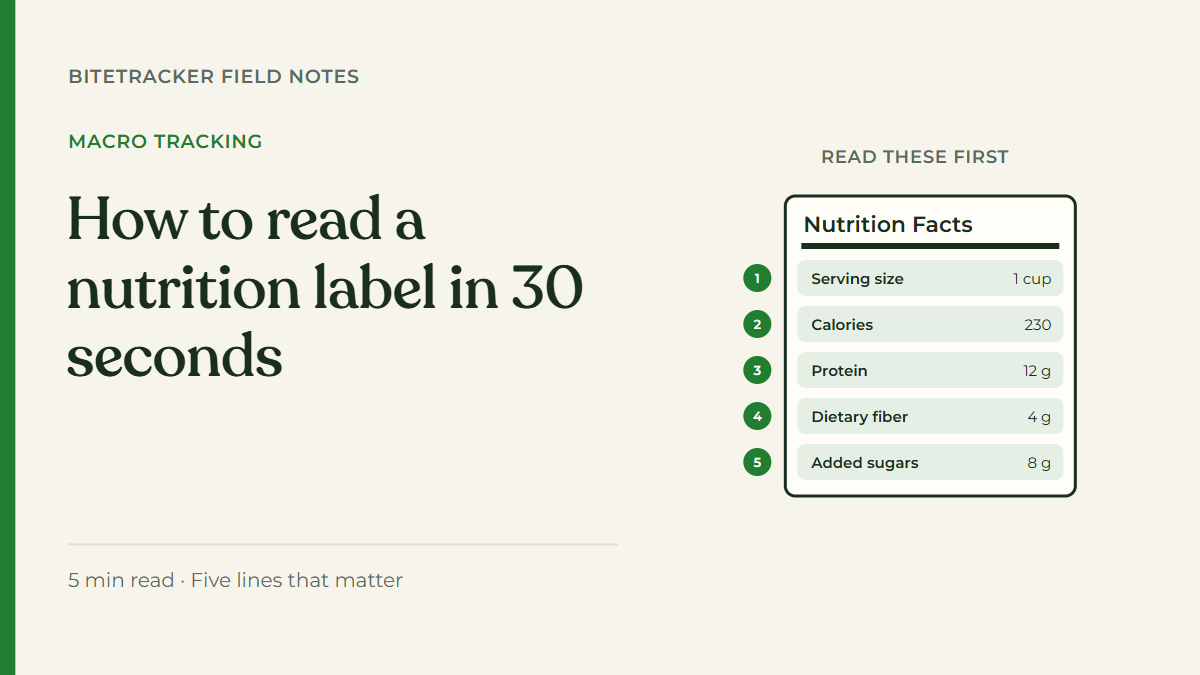
- Serving size first. Every number on the label is for one serving, and a package often holds more than one.
- Then calories, protein, fiber and added sugars. For most food choices, that is enough.
- Percent Daily Value is a quick scale: 5% or less of a nutrient per serving is low, and 20% or more is high.
Read the label in this order
Start at the top, and stop once you have what you need.
Check the serving size
Everything on the label is per serving. A bag of chips might list 150 calories per serving and hold three servings. If you eat the whole bag, multiply every number by three, which makes it 450 calories. This is the step people skip, and it is the one that matters most.
Read calories and protein
Calories tell you how the food fits your target. Protein tells you how filling it is likely to be. A snack with 200 calories and 15 grams of protein does a very different job from one with 200 calories and 2 grams.
Glance at fiber, added sugars and sodium
Fiber helps with fullness, so more is usually better. Added sugars are the sugars put in during processing, separate from the natural sugar in fruit or milk. Use the %DV column here: 20% or more is a lot, which is good news for fiber and a warning for added sugars and sodium.
How do you read a nutrition label?
To read a nutrition label, start with the serving size and servings per container, because every number below them is for one serving. Then check calories, protein, fiber and added sugars. Use the percent Daily Value column as a quick scale: 5% or less of a nutrient is low, and 20% or more is high.
That order follows how the FDA suggests reading the Nutrition Facts label, trimmed to what matters for calorie and macro tracking. The rest of the panel, like cholesterol and the vitamin and mineral rows, matters for specific health goals but rarely changes a daily food choice.
- Serving size and servings per container: the multiplier for everything else.
- Calories: how much of your daily target one serving uses.
- Protein: the macro that makes food filling, and the one most people run short on.
- Total fat and total carbohydrate: useful if you track all three macros.
- Dietary fiber: helps meals keep you full.
- Added sugars and sodium: the two lines most worth keeping low.
Why serving size changes every number
The serving size is a reference amount, not a recommendation of how much to eat. If you eat two servings, you get double the calories and double every nutrient on the panel.
Worked example: a package lists 1 cup as a serving, with 230 calories, 12 grams of protein, 4 grams of fiber and 8 grams of added sugars, and it holds 3 servings. Eat 1.5 cups and you log 345 calories, 18 grams of protein, 6 grams of fiber and 12 grams of added sugars. Eat the whole package and it is 690 calories.
Some packages that people often finish in one sitting, like a pint of ice cream, show two columns: per serving and per package. If you ate the whole thing, read the per-package column. Watch foods with small servings that are easy to overpour, such as cereal, granola, nuts and nut butter, where a normal bowl can be two or three servings.
What does percent Daily Value mean?
The percent Daily Value, or %DV, shows how much one serving contributes to a reference daily amount of each nutrient. It is based on 2,000 calories a day, which the FDA uses as a general guide; your own needs may be higher or lower.
You do not need to add the percentages up. Use them to compare foods and to judge a single serving: 5% DV or less is low and 20% DV or more is high. In general, aim higher for fiber and lower for added sugars, sodium and saturated fat.
- Added sugars: Daily Value 50 g, so 10 g of added sugars is 20% DV.
- Dietary fiber: Daily Value 28 g, so 6 g of fiber is about 21% DV.
- Sodium: Daily Value 2,300 mg, so 460 mg in one serving is 20% DV.
- Protein: often shown in grams with no %DV, because a %DV is only required in certain cases, such as when the package makes a protein claim.
Added sugars vs total sugars: what is the difference?
Total sugars include the sugar naturally present in foods like milk and fruit, plus any sugar added during processing. Added sugars are the part that was put in: table sugar, syrups, honey, and sugar from concentrated fruit or vegetable juice beyond what the same amount of 100% juice would contain.
Plain yogurt, for example, shows a few grams of total sugars from the milk and 0 grams added. A flavored yogurt shows more total sugars, with most of the difference listed under added sugars. That second line is the one to watch, and its Daily Value of 50 grams works as a limit rather than a target.
Which numbers matter most for weight loss?
In a calorie deficit, calories decide how a food fits your day, and protein and fiber decide how full it keeps you. A useful quick check is protein per 100 calories: divide the grams of protein by the calories, then multiply by 100.
- 10 g or more per 100 calories: a strong protein source. Plain nonfat Greek yogurt and canned tuna sit here.
- 5 to 10 g per 100 calories: a solid contributor. The 230-calorie example above, with 12 g of protein, works out to about 5 g per 100.
- Under 3 g per 100 calories: mostly carbs or fat. Many granolas and crackers sit here, including some with protein on the front of the box.
Front-of-package claims and the ingredients list
The front of the package is marketing; the Nutrition Facts panel is information. Words like natural, made with whole grains or protein do not tell you how much of anything is inside. A granola labeled high protein may still carry more added sugar than protein per serving.
The ingredients list fills in the rest. Ingredients appear in order by weight, from most to least, so if sugar or a syrup is among the first few, it makes up a large share of the food. Several different sweeteners spread through the list add up in the same way.
Sauces, dressings and oils deserve a second look, because their servings are small and their calories are not. Our guide to hidden calories in oils, sauces and drinks covers the worst offenders.
How to read a nutrition label when you track calories
In the store, the label helps you choose. At home, it tells you what to log, and serving size is again the step that matters: log the amount you actually ate, not the amount printed on the panel. If you are working toward a daily number, how much protein you need to lose weight explains how to set it, and the protein-per-100-calories check shows which foods help.
Labels on cooking ingredients feed straight into a recipe. See how to count calories in homemade meals to total a pot and divide it into servings.
In BiteTracker, scanning the barcode fills in the label for you. Change the serving to what you ate and the calories and macros update, with no arithmetic to get wrong. For food without a label, estimating portions without a food scale fills the gap.
Frequently asked questions
What is the most important thing to look at on a nutrition label?
The serving size. Every number on the Nutrition Facts label is for one serving, and many packages hold two or more. Check the servings per container, compare the serving with what you will really eat, and multiply the calories and nutrients to match.
Is 20% daily value a lot?
Yes. The FDA's rule of thumb is that 20% DV or more of a nutrient in one serving is high, and 5% DV or less is low. That makes 20% or more a good sign for fiber and a warning sign for sodium, saturated fat or added sugars.
How many grams of added sugar a day is on the nutrition label?
The Daily Value for added sugars on the Nutrition Facts label is 50 grams a day, based on a 2,000-calorie diet. It works as an upper limit rather than a target, so a food with 10 grams of added sugars per serving already uses 20% of it.
Why is there no percent daily value for protein?
Food makers only have to show a %DV for protein in certain cases, such as when the package makes a protein claim. Otherwise protein is listed in grams only. Judge it in grams instead, or divide grams of protein by calories and multiply by 100 to compare foods.
Scan the barcode in BiteTracker
Scan a package and BiteTracker fills in the calories and macros. Adjust the serving to what you actually ate and save.
Sources
- How to Understand and Use the Nutrition Facts Label, U.S. Food and Drug Administration
- Added Sugars on the Nutrition Facts Label, U.S. Food and Drug Administration
- Daily Value on the Nutrition and Supplement Facts Labels, U.S. Food and Drug Administration
This article is general information, not medical advice. If you have a health condition, talk to your doctor or a registered dietitian before changing how you eat.