How to count calories in homemade meals
Knowing how to count calories in homemade food turns home cooking into the easiest part of your log. Count the whole pot once, divide it by servings or by weight, and reuse the result every time you cook the dish.
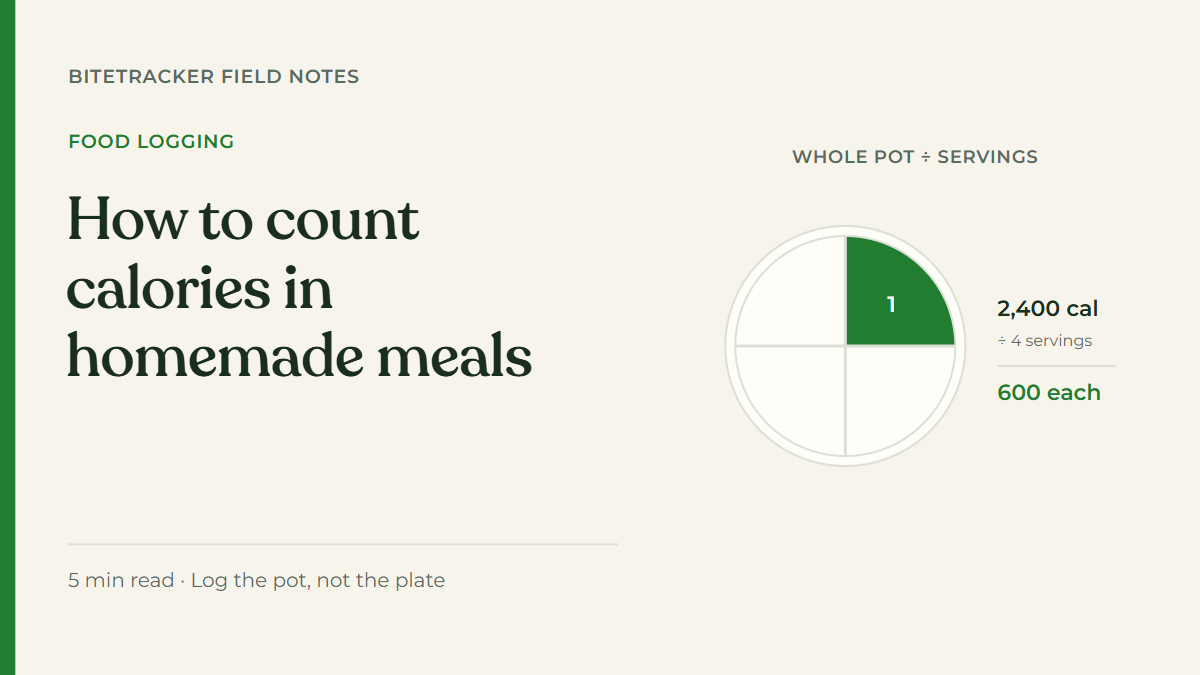
- Add up every ingredient in the pot, including the oil, then divide by the number of servings.
- For dishes served by the ladle, weigh or measure the finished food and log your portion as a share of it.
- Save the dish as a recipe. Next time, logging a serving takes one tap.
Count it once, reuse it forever
A recipe you cook regularly only needs to be counted one time.
List what went in
Enter every ingredient and its amount: the pound of ground beef, the can of tomatoes, the tablespoon of oil, the cup of dry rice. Use raw or dry amounts where you can, and scan packaged ingredients. Do not skip the cooking fat; it is often one of the biggest calorie items in the pot.
Decide the servings
Split the pot into the number of portions you actually serve. If a chili feeds four people, that is four servings. If you portion it into containers, count the containers. Each serving now has its own calories, protein, carbs and fat.
Save and repeat
Save the dish as a recipe. The next time you cook it, you only need to log one serving, and small extras, like cheese on top, can be added as a separate line.
How do you count calories in homemade food?
To count calories in homemade food, list every ingredient with its amount, look up or scan the calories for each, and add them together. Divide the total by the number of servings, or by the finished weight if portions vary. Save the result as a recipe so you only do the math once.
Searching a food database for beef stew gives you a stranger's recipe, not yours. Counting from ingredients reflects your pan, your oil and your portions, which is how home cooking can become the most accurate part of your log instead of the least.
Worked example: a pot of chili
Here is a simple beef and bean chili, with rough values of the kind you will find on package labels and in the USDA's FoodData Central. Your brands will differ a little; the method is the point.
- 1 pound 90% lean ground beef, raw: about 800 calories, 90 g protein.
- 1 tablespoon olive oil: about 120 calories.
- 1 large onion: about 60 calories.
- 2 cans kidney beans, drained: about 630 calories, 40 g protein.
- 1 28-ounce can crushed tomatoes: about 250 calories, 12 g protein.
- Garlic, spices and a splash of broth: small enough to log as one line or skip.
- Total: about 1,860 calories and 145 g protein. Split 4 ways, each bowl is about 465 calories and 36 g protein. Split into 6 containers, each is about 310 calories and 24 g.
How to count calories in homemade food served by the ladle
A tray of lasagna cut into eight is easy to split. A pot of soup or chili is not, and eyeballing a bowl undoes the careful counting. Divide by the finished amount instead.
- Weigh the empty pot before you cook, or weigh it once and note the number.
- Weigh the pot again when the dish is done and subtract to get the weight of the finished food.
- Divide the recipe's total calories by that weight to get calories per gram.
- Weigh your bowl of food and multiply.
Finished-weight math, with and without a scale
Using the chili above: if the finished food weighs 2,000 grams, that is about 0.93 calories per gram. A 350-gram bowl is about 325 calories.
No kitchen scale? Measure the finished volume instead. If the pot holds about 8 cups, each cup is about 230 calories, and a ladle or bowl you have measured once with a measuring cup does the rest.
Should you log ingredients raw or cooked?
Enter ingredients at raw or dry weight, the way they are sold and labeled. Cooking changes weight far more than it changes calories: meat loses water and shrinks, while rice and pasta absorb water and get heavier. A cup of dry rice becomes roughly 3 cups cooked.
Mixing the two is the most common homemade-food error. If you measure 1 cup of dry rice but pick a cooked-rice entry, the recipe undercounts that rice by about two thirds. Whatever you measure, make the database entry match it.
Don't skip the oil, butter and toppings
Measure oil and butter with a spoon even if you estimate everything else. A tablespoon of oil is about 120 calories and a tablespoon of butter about 100, and a free pour into a hot pan is often two or three tablespoons. Our guide to hidden calories in oils, sauces and drinks shows where else these add up.
Log toppings added at the table as separate lines: cheese, sour cream, nuts, dressing. They vary from bowl to bowl, and keeping them out of the recipe keeps the base numbers true. If you drain fat from browned meat, you can leave the recipe as entered; the count will run a little high, which is the safer direction.
Batch cooking, family dinners and recipe changes
Batch cooking makes counting even easier: one recipe, many identical portions. Set the servings to the number of containers you fill, portion with the same ladle, and write the calories and protein on the lid if you freeze them. A few batch-friendly dinners are the core of meal planning without cooking every night.
Cooking for others works the same way: count the whole dish, then log your share. If you served yourself a quarter of the pan, log a quarter. When someone else cooks and you cannot see the ingredients, estimate the plate with hand portions instead of a scale.
Small changes, like swapping one vegetable for another, barely move the total. If you double the oil, add a cup of cream or switch to a fattier cut of meat, edit the recipe or save a second version. For canned and packaged ingredients, reading the nutrition label correctly, including servings per container, keeps the totals honest.
Build a small library of saved recipes
Most households cook the same 10 to 15 meals. Once those are saved, home cooking becomes the easiest food to track. In BiteTracker, create a recipe from its ingredients, set the servings and save it; after that, a serving is one tap. You can drag it onto the meal-planning calendar and order the ingredients through Instacart when you plan the week.
For a head start, the BiteTracker recipe book lists calories and protein per serving for every dish, so you can cook from recipes that are already counted.
Frequently asked questions
How do I calculate calories per serving of a recipe?
Add up the calories of every ingredient, including cooking oil, to get the recipe total, then divide by the number of servings. A pot of chili totaling 1,860 calories split into 6 equal containers is about 310 calories each. If servings are uneven, divide by the finished weight instead.
Do calories change when food is cooked?
Cooking mostly changes weight, not calories. Meat loses water and weighs less, while rice, pasta and dried beans absorb water and weigh more. The calories stay roughly the same, so enter ingredients raw or dry, then divide the recipe total by servings or by the cooked weight.
How do I count calories in homemade soup?
Total the calories of the ingredients, then measure the finished soup by weight or in cups. Divide the total by that amount to get calories per gram or per cup, and log your bowl by how much it holds. Measure a bowl or ladle once so later servings are quick.
Is it worth counting calories if I cook healthy food at home?
Yes, at least once per dish. Healthy home cooking can still carry a lot of oil, cheese, nuts or grains, and those calories are hard to see on the plate. Counting a recipe once tells you what a serving really contains, and after that it takes no extra effort.
Save homemade recipes in BiteTracker
Create a recipe from its ingredients, set the servings, and log a portion in one tap every time you cook it.
Sources
- FoodData Central, U.S. Department of Agriculture
- How to Understand and Use the Nutrition Facts Label, U.S. Food and Drug Administration
- Steps for Losing Weight, Centers for Disease Control and Prevention
This article is general information, not medical advice. If you have a health condition, talk to your doctor or a registered dietitian before changing how you eat.