Hidden calories: how to track oils, sauces and drinks
The meal is logged; the oil it was cooked in is not. Hidden calories in oils, sauces and drinks are one of the most common reasons a food log and the scale disagree, and three small habits catch nearly all of them.
- One tablespoon of cooking oil is about 120 calories. A free pour from the bottle is often two or three.
- Sauces, dressings and spreads are dense in calories and easy to forget. Log them as their own line.
- Drinks count. Coffee drinks, juice, soda and alcohol can add several hundred calories a day.
Three habits that close the gap
You do not need to weigh your dinner. You need to notice the few things that carry a lot of calories in a small amount.
Measure the oil
Use a tablespoon when you cook instead of pouring from the bottle. It takes two seconds and removes the biggest single source of error in home cooking. If you cook for others, log your share of the oil in the pan.
Log sauces as a separate line
Add dressings, mayonnaise, pesto, peanut sauce and cheese as their own entries, not buried inside the meal. Two tablespoons of ranch or mayonnaise can be 130 to 200 calories, and they vanish from memory once they are inside a sandwich or salad.
Log drinks when you pour or order them
Log drinks at the moment you pour or order them, before they become background. A large flavored latte can be 250 to 400 calories, and a second glass of wine or beer is easy to forget by the next morning.
What are hidden calories?
Hidden calories are the calories in things you eat or drink but tend not to log, because they are small, poured, or part of something else. The biggest sources are cooking oil and butter, sauces and dressings, and drinks such as coffee drinks, juice, soda and alcohol. Each looks minor, but together they can add several hundred calories a day.
The reason is density. Fat has about 9 calories per gram, more than twice as much as protein or carbohydrate at about 4. A tablespoon of oil looks like almost nothing in a pan, yet it has about as many calories as a large banana. Alcohol has about 7 calories per gram, and for many people drinks are less filling than food with the same calories.
Hidden calories in cooking oil and butter
Oil is the classic missing entry, because it goes into the pan rather than onto the plate. All common cooking oils are close to 120 calories per tablespoon, whether olive, canola, avocado or coconut. Butter is about 100.
Here is a worked example. You roast vegetables and chicken for four people with 3 tablespoons of olive oil, about 360 calories. Your share is about 90 calories. That is small on its own, but if it goes unlogged at one meal a day, it adds up to about 630 calories a week. Building the dish as a saved recipe, as in our guide to counting calories in homemade food, counts the oil once and splits it for you.
- Cooking spray is not zero. Labels use a tiny serving, so a long spray adds real calories.
- Roasted, sauteed and fried foods have absorbed fat that a photo cannot show.
- Restaurant kitchens tend to use more fat than home cooks, so round up when eating out.
Hidden calories in sauces, dressings and spreads
These are rough values for common portions. They vary by brand and recipe, so check the label when you have it, and look closely at the serving size: our guide to reading a nutrition label explains why that line matters most.
- Mayonnaise, 1 tablespoon: about 90 to 100 calories.
- Ranch or Caesar dressing, 2 tablespoons: about 130 to 170 calories.
- Pesto, 2 tablespoons: about 120 to 160 calories.
- Peanut butter, 2 tablespoons: about 190 calories.
- Shredded cheese, a quarter cup: about 110 calories.
- Barbecue sauce, 2 tablespoons: about 50 to 70 calories.
- Ketchup, 1 tablespoon: about 20 calories. Mustard, hot sauce and salsa: very little.
Hidden calories in drinks
Drinks are easy to leave out because they are not a meal. For alcohol, the NIAAA Rethinking Drinking site has a calorie calculator that helps with cocktails and larger pours. Home pours of wine are often bigger than the standard 5 ounces, so log what is actually in the glass.
- Large flavored latte: about 250 to 400 calories, depending on milk and syrup.
- Orange juice, 8 ounces: about 110 calories.
- Regular soda, 12 ounces: about 140 to 150 calories.
- Regular beer, 12 ounces: about 150 calories.
- Wine, 5 ounces: about 120 calories.
- Spirits, 1.5 ounces of 80 proof: about 100 calories, before any mixer.
- Half-and-half, 1 tablespoon: about 20 calories. Heavy cream: about 50.
How much do hidden calories add up?
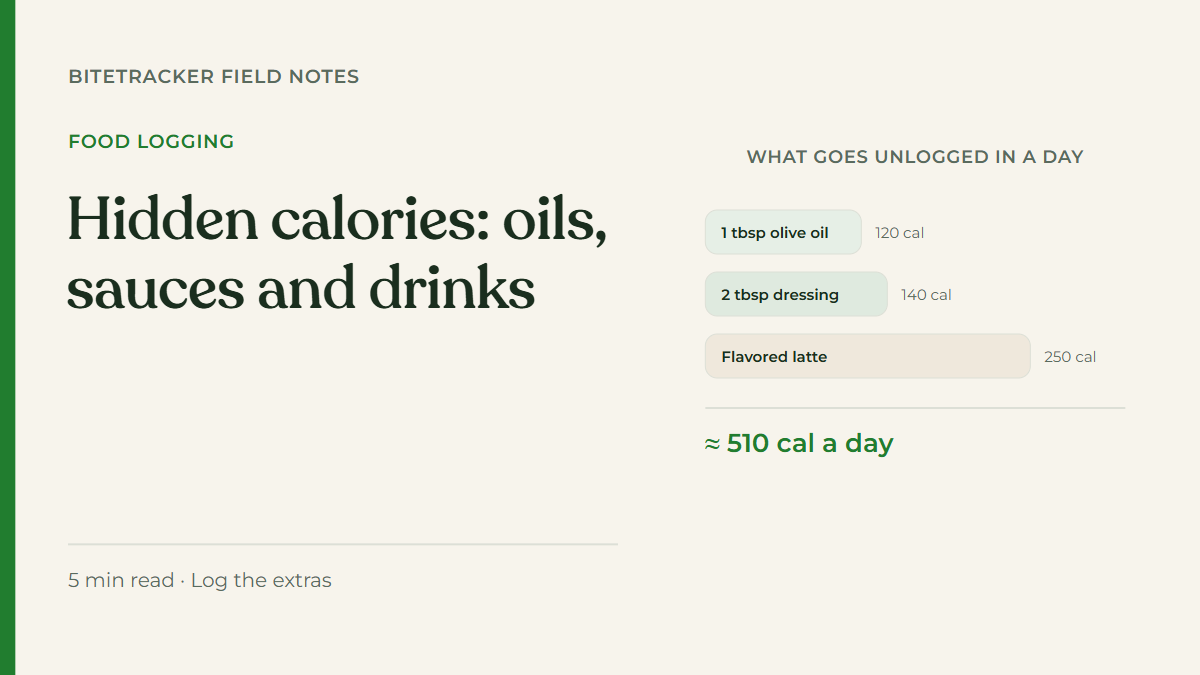
Suppose you miss one tablespoon of olive oil (about 120 calories), two tablespoons of dressing (about 140) and one flavored latte (about 250) on a typical day. That is about 510 calories a day that never reach your log, which is as large as a typical 300 to 500 calorie deficit, or larger.
Over a week, that is about 3,500 calories, or roughly a pound of body fat by the common rule of thumb. The rule is only a rough guide, because the body adapts and weight changes more slowly over time, but the direction is clear: a log that is missing these extras will look like a deficit while the scale stays flat. If that sounds familiar, our guide to gaining weight in a calorie deficit covers the other causes to rule out. Judge it on your weekly average weight over 2 to 4 weeks, not a single weigh-in.
Do you need to cut oils, sauces and drinks?
No. Oil, sauces and drinks make food enjoyable, and fats from sources like olive oil and nuts are part of a healthy diet. You just need to count them, so your target reflects what you actually eat. If you want to trim, a few easy swaps save calories without making meals bland.
- Measure oil with a spoon instead of pouring. Most dishes need less than you think.
- Ask for dressing on the side and dip your fork, especially when tracking calories when eating out.
- Choose a smaller coffee size or one less pump of syrup.
- Alternate alcoholic drinks with water or a zero-calorie drink.
- Cook from lower-calorie recipes that already count the oil per serving.
Make hidden calories easy to log
A meal photo cannot see cooking oil or the sugar in a drink, which is why AI photo calorie tracking works best with a quick review. The fix is a separate entry for each extra, and the easier that entry is, the more often it happens.
In BiteTracker, add extras in a single sentence, like 'a tablespoon of olive oil and a medium oat latte', or scan the barcode on the bottle. Save the drinks you order often so they take one tap. Within a week or two, the gap between your log and your results usually starts to close.
Frequently asked questions
How many calories are in a tablespoon of olive oil?
About 120 calories. Other common cooking oils, including canola, vegetable, avocado and coconut oil, are very similar, because they are almost pure fat at about 9 calories per gram. A tablespoon of butter is a little lower, at about 100 calories, because butter also contains some water.
Should I count calories in coffee?
Black coffee and plain tea have almost no calories, so most people skip them. What you add is what counts: milk, cream, sugar and syrups. A splash of milk is small, but a large flavored latte can be 250 to 400 calories, so log coffee drinks like any other food.
Do condiments like mustard and hot sauce count?
Mustard, hot sauce, salsa, vinegar and soy sauce are low enough that a normal amount barely changes your total, though soy sauce is high in sodium. Ketchup is about 20 calories per tablespoon, so log it if you use a lot. Creamy and oil-based sauces are the ones to log every time.
Why are liquid calories easy to overdo?
Drinks go down quickly and, for many people, do not feel as filling as food with the same calories, so they rarely lead you to eat less later. Juice, soda, sweetened coffee and alcohol can add several hundred calories a day without feeling like a meal. Logging them when you pour them keeps them visible.
Add oils, sauces and drinks in seconds
Describe the extras in a sentence, like a tablespoon of olive oil and an oat milk latte, or scan the bottle's barcode, and BiteTracker adds them to your day.
Sources
- FoodData Central, U.S. Department of Agriculture
- Rethinking Drinking, National Institute on Alcohol Abuse and Alcoholism (NIH)
- How to Understand and Use the Nutrition Facts Label, U.S. Food and Drug Administration
- Quantification of the effect of energy imbalance on bodyweight, Hall KD et al., The Lancet, 2011
This article is general information, not medical advice. If you have a health condition, talk to your doctor or a registered dietitian before changing how you eat.