How to stay consistent with calorie tracking during busy weeks
Consistent calorie tracking when busy is not about more discipline. Tracking falls apart when the week gets full, not when it gets hard, and the fix is a smaller version of the habit that still works on your worst days.
- Define a minimum log before the week starts: one rough entry per meal, with calories and protein, is enough to keep the week useful.
- Repeat breakfasts and lunches on busy weeks. Fewer decisions means fewer missed entries.
- A two-minute check before bed catches the meals you forgot while they are still easy to remember.
Shrink the habit, keep the streak
Decide in advance what counts as tracking on a busy day, so you never have to decide in the moment.
Write down your minimum
Your normal routine might include weighing portions and logging each ingredient. Your minimum is much smaller: one entry per meal, estimated in a sentence. Decide this before the week starts. When the day gets away from you, you already know what is good enough.
Put repeat meals on autopilot
Pick one breakfast and one lunch you will eat most days this week and save them. Logging then becomes a tap, and there is no daily decision about what to eat or how to enter it. Variety can come back at dinner.
Close the day in two minutes
Before bed, open the day and fill any empty slot with a best guess. This single check catches most misses. A day with a rough dinner estimate is far more useful than a day with no dinner at all.
How do you stay consistent with calorie tracking when you are busy?
Consistent calorie tracking when busy comes from shrinking the habit, not pushing harder. Decide in advance on a minimum log, usually one rough entry per meal. Repeat the same breakfast and lunch so they take a tap to log, and do a two-minute check before bed to fill any empty slot.
That minimum is not a lower standard. It is a second version of the habit, built for the weeks when the full version is impossible. Most people already have the full version; what they lack is the busy-week one.
Why busy weeks break the habit
Most people do not stop tracking because it stops working. They stop because a busy week makes the full routine impossible, a few days go blank, and restarting feels like starting from zero. The habit was built for normal weeks and had no version for bad ones.
Busy weeks also change what you eat. More takeout, more snacks at the desk, later dinners. Those are exactly the meals that take longest to log, so logging and eating well tend to slip together. A missed Monday lunch becomes a blank Tuesday, and by Thursday the log feels too far behind to bother with. The minimum log exists to break that chain on day one.
Why consistent calorie tracking matters more than precision
A systematic review of self-monitoring research found a consistent, significant association between self-monitoring, of diet, exercise or weight, and weight loss. The CDC likewise recommends keeping food and activity logs. What the research rewards is showing up regularly, not recording every gram.
A worked example shows why. Say your real intake is 1,750 calories on four weekdays and 2,400 on three busy days that you leave blank. Your log shows an average of 1,750, but the truth is about 2,030. If you had logged every day with rough estimates that ran 150 calories low, the log would read about 1,880: still a little low, but much closer to what actually happened.
What does a minimum calorie log look like?
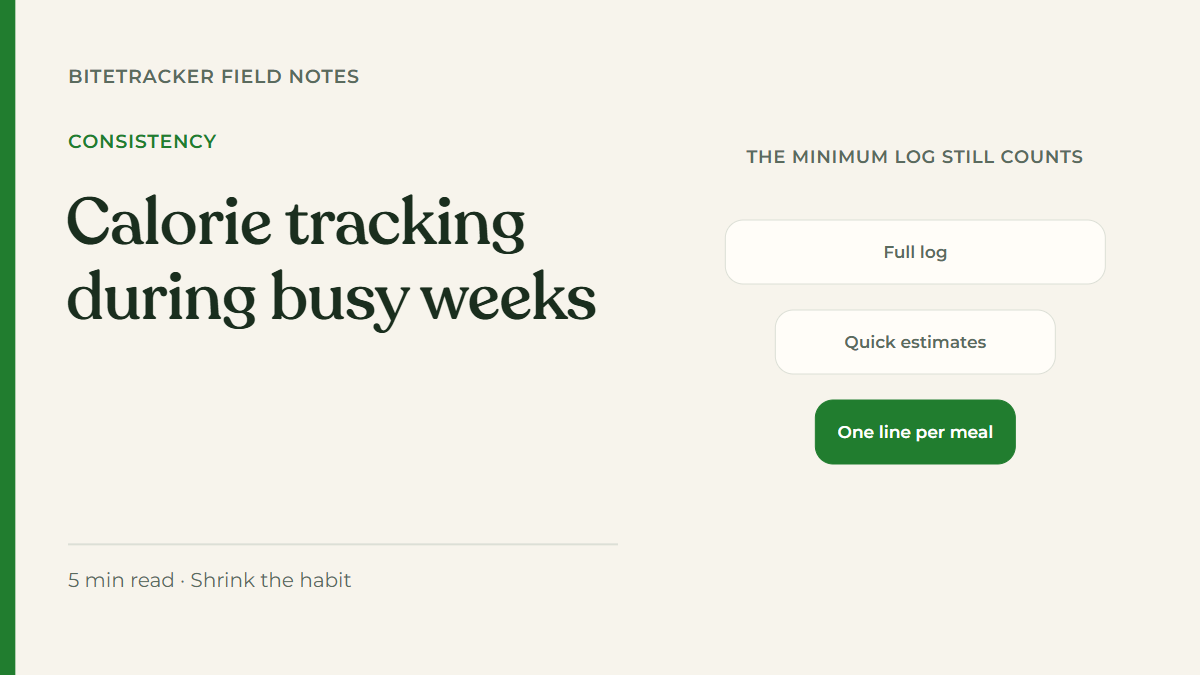
Think of tracking as three levels, and pick the lowest one you can keep up this week. Dropping a level is a plan, not a failure. On a normal week you might sit at the top; on a week of late meetings and travel, the bottom level is enough to keep the habit and the weekly average alive.
- Full log: portions measured or carefully estimated, every ingredient entered, all macros.
- Quick estimates: each meal entered by its main parts, calories and protein checked.
- One line per meal: a single sentence per meal, such as two slices of pepperoni pizza and a soda, with nothing else.
Shortcuts that keep logging under a minute
A rough week of data is worth much more than a perfect week that never happened. These shortcuts give up a little accuracy and keep almost all of the value. For more ways to strip tracking back, see simple calorie tracking.
- Describe the meal in one sentence instead of adding each ingredient.
- Copy yesterday's breakfast instead of logging it again.
- Track calories and protein only, and let the other macros go for the week.
- Estimate takeout by its main parts: protein, starch, sauce. Our guide to tracking calories when eating out has typical ranges.
- Log before you eat when you can. It takes the same time and is never forgotten.
Plan the food, not just the log
Busy weeks are easier to track when they are easier to eat. A few meals planned ahead, a grocery order placed once and two repeat lunches remove most of the daily choices. Every meal you did not have to decide on is a meal you are more likely to log.
You do not need an elaborate plan. The one-hour weekly meal plan sets up a week in a single sitting, and cooking two or three batch bases on Sunday covers most busy weeknight dinners.
What to do after a busy week
When things calm down, return to your normal routine without trying to make up for the busy week. Do not cut calories to compensate. If a day or two went fully blank, follow the steps for what to do when you forget to log food and then move on rather than rebuilding the week in detail.
Keep weighing yourself if that is part of your routine. Research on self-weighing links regular weigh-ins with more weight loss and not with depression or anxiety, and a weekly average weight fills in some of what a thin log misses. Then note what made logging hard, and adjust the minimum for next time.
Make consistent calorie tracking fast
In BiteTracker, save your repeat meals, copy meals from earlier days and describe anything new in a sentence. On iPhone, the Live Activity keeps your calories and meal slots on the lock screen, so the minimum takes a few seconds even on the busiest day. The weekly report then shows your average calories and protein, so you can see whether a busy week actually went off plan or just felt that way.
Frequently asked questions
Is it OK to track calories only on some days?
It is better than nothing, but partial tracking tends to skip the harder days, like weekends and busy days, so your average looks lower than it really is. A rough estimate every day usually gives a truer picture than careful logs on only four or five days.
How long does it take to make calorie tracking a habit?
It varies a lot from person to person, and there is no fixed number of days. What helps most is making the habit small and tying it to something you already do, such as logging breakfast while your coffee brews or doing a quick check before bed.
Should I stop tracking during a stressful week?
Usually it is better to track less than to stop completely. Switch to one line per meal and keep going; restarting after a full break is harder than continuing a lighter version. If tracking itself is adding real stress or affecting how you feel about food, talk to your doctor or a registered dietitian.
What is the fastest way to log a meal?
Repeating a saved meal or copying one from a previous day is fastest, usually a single tap. For something new, describing it in one sentence or scanning a barcode takes a few seconds. Photo logging is quick too, as long as you review the suggested portions before saving.
Keep the log going on your busiest days
Copy meals from a previous day, re-add a saved meal or describe a meal in one sentence. On iPhone, the Live Activity keeps your calories and meal slots on the lock screen.
Sources
- Self-monitoring in weight loss: a systematic review of the literature, Burke LE et al., Journal of the American Dietetic Association, 2011
- Steps for Losing Weight, Centers for Disease Control and Prevention
- Self-weighing in weight management: a systematic literature review, Zheng Y et al., Obesity, 2015
This article is general information, not medical advice. If you have a health condition, talk to your doctor or a registered dietitian before changing how you eat.